
A wedding officiant is the individual legally authorized to solemnize a marriage, guiding couples through their vows and ensuring all legal requirements for the union are met.
This crucial role encompasses both the heartfelt delivery of your ceremony and the meticulous handling of official marriage documentation, varying significantly by local jurisdiction and the type of officiant chosen.
Key Takeaways:
- A wedding officiant is legally empowered to perform and validate your marriage ceremony.
- Their duties span ceremony planning, leading the service, and filing the official marriage license.
- Officiants can be religious leaders, civil officials, professional celebrants, or even temporary-ordained friends or family.
- Legal requirements for officiants and marriage vary significantly by state and county.
- Today, average officiant costs range from $0 for civil servants to $900+ for highly customized professional services.
- Choosing the right officiant is paramount for a seamless ceremony and a legally binding marriage.
- BjornandCompany’s Premium Wedding Planning Service can manage all officiant coordination, ensuring flawlessly executed legal and ceremonial details.
What Is a Wedding Officiant?
A wedding officiant is the pivotal figure who formalizes your union, transforming your heartfelt promises into a legally recognized marriage. This professional guides you through the sacred or secular vows and ensures every legal detail, from signing the marriage license to its proper filing, is impeccably handled.
Their expertise provides a steady, practical guide, allowing you to focus purely on your timeless moments.
Choosing the right officiant is an early, vital step in What To Do First When Planning A Wedding: A Complete Guide. This role extends far beyond merely reading a script; it’s about crafting an unforgettable experience that reflects your unique love story while upholding all necessary legal parameters. Let us craft this seamless coordination for you.
What Does a Wedding Officiant Do?
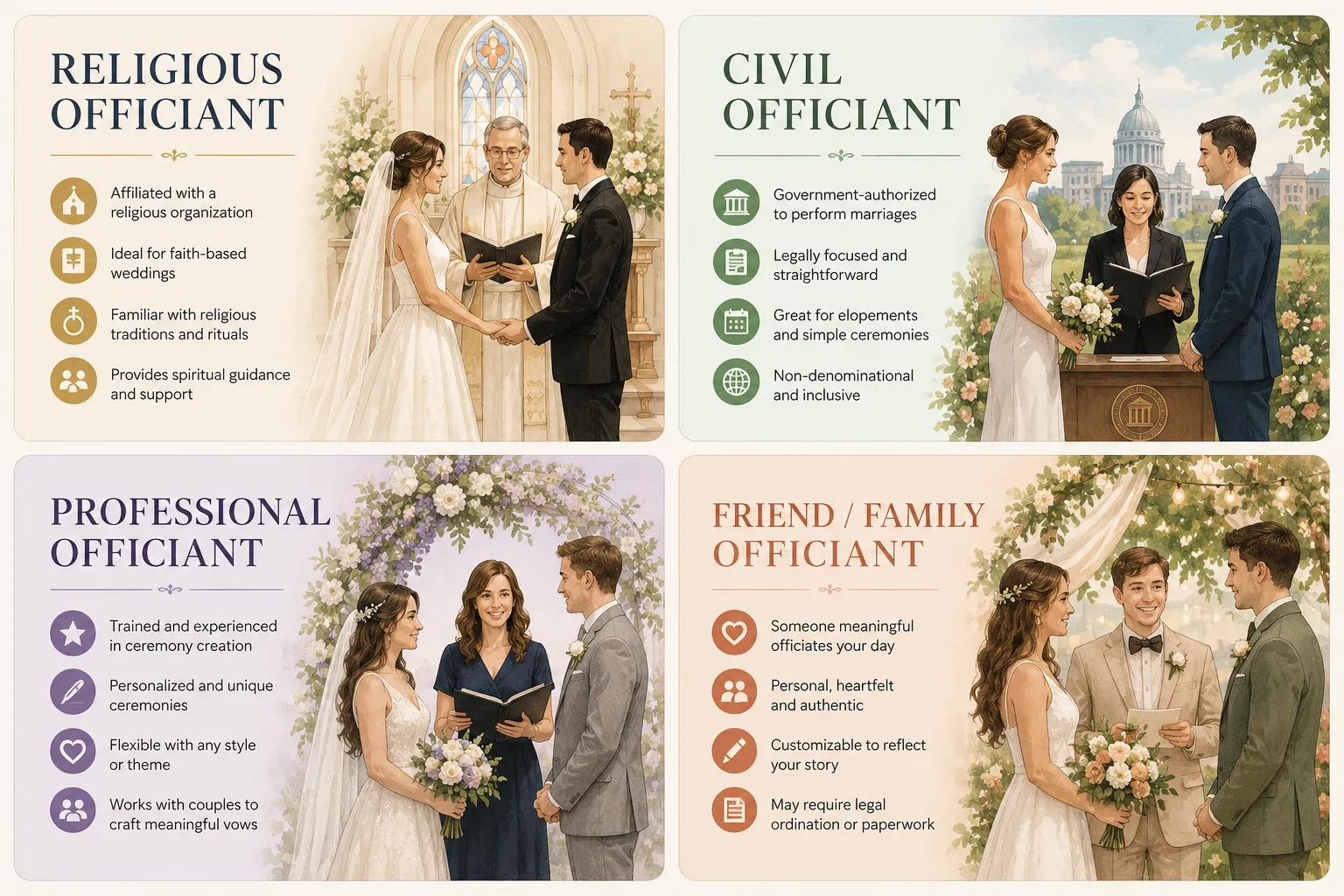
A wedding officiant’s responsibilities are comprehensive, spanning before, during, and after your momentous day to ensure your marriage is both beautiful and legally sound. They are the steady hand behind the scenes, managing complexities with unmatched elegance and excellence.
Before the Wedding
Before your wedding day, your officiant invests significant time in preparation. This includes initial consultations to understand your vision, values, and relationship, collaborating on a custom ceremony script, and advising on elements like What Are Wedding Vows or special readings.
They will also guide you through obtaining your marriage license and confirming all local legal requirements are met. This meticulous planning guarantees your ceremony is perfectly personalized and legally compliant.
During the Ceremony
On your wedding day, the officiant orchestrates the flow of your ceremony, ensuring every transition is seamless and every word resonates.
They lead the processional, deliver a heartfelt address, guide you and your partner through your vows and ring exchange, and formally pronounce you married. Their presence is authoritative yet warm, ensuring the ceremony remains a deeply personal and emotionally impactful experience.
After the Ceremony
Once you’ve exchanged “I do’s,” the officiant’s legal duties continue. They are responsible for signing the marriage license, often alongside your witnesses, and then promptly filing it with the appropriate government office, usually the county clerk.
This critical step legally registers your marriage and secures your marital status. Our comprehensive Premium Wedding Planning Service ensures these vital post-ceremony details are handled with absolute precision.
Who Can Officiate a Wedding?
The authority to officiate a wedding varies by jurisdiction, offering diverse options to suit every couple’s preference. Whether you envision a deeply spiritual service or a lighthearted, personal exchange, there is an officiant type perfectly suited for your day.
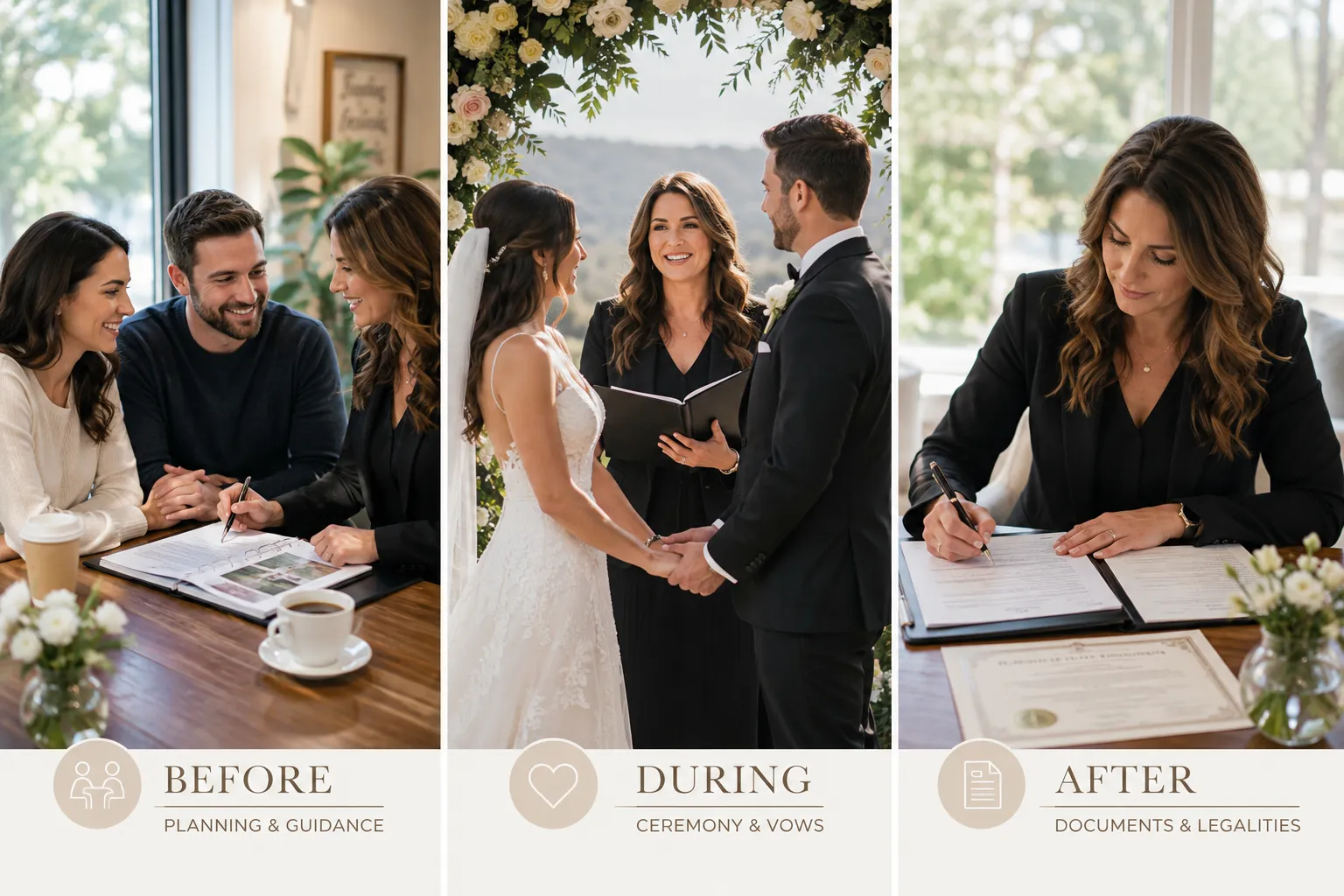
| Officiant Type | Best For | Typical Cost (2026 Estimate) | Customization Level | Legal Complexity |
|---|---|---|---|---|
| Religious | Faith-based ceremonies, spiritual guidance | $0, $500 (donation) | Medium | Medium |
| Civil | Simple, legal-focused, courthouse ceremonies | $25, $200 | Low | Low |
| Professional | Highly personalized, secular or interfaith | $300, $1,200+ | High | Low-Medium |
| Friend/Family | Intimate, deeply personal, unique ceremony | $0, $250 (ordination/travel) | High | High |
Religious Officiant
Religious officiants are clergy members (ministers, priests, rabbis, imams, etc.) authorized by their respective religious institutions. They conduct ceremonies according to their faith’s traditions and rituals. Choose a religious officiant if a ceremony rooted in specific spiritual traditions is paramount to your wedding vision.
Civil Officiant
Civil officiants are authorized by the state or local government, such as judges, justices of the peace, or county clerks. Their ceremonies are typically brief and legally focused, often held in a courthouse. This option is ideal if you prioritize a straightforward legal union without extensive ceremonial frills.
Professional Officiant
Professional officiants or celebrants are individuals specifically trained and certified to perform weddings. They often specialize in crafting unique, personalized ceremonies that reflect the couple’s values, stories, and cultural backgrounds. Opt for a professional officiant if you desire a deeply customized, non-denominational ceremony that truly captures your essence.
Friend or Family Member
Many couples choose a close friend or family member to officiate, adding an incredibly personal touch to their day. While this option offers immense sentimental value, it comes with specific legal requirements. The individual must typically become legally ordained or registered according to local laws.
This path is perfect if a deeply intimate connection with your officiant is a top priority, provided all legal mandates are diligently followed. For detailed guidance, explore How To Become A Wedding Officiant.
Online-Ordained Officiant
In many jurisdictions, individuals can become legally authorized officiants through online ordination. This method is often chosen by friends or family members who wish to perform a wedding. However, it is crucial to verify the legality of online ordinations in your specific wedding location, as state and county regulations vary widely.
Do You Legally Need a Wedding Officiant?
A wedding officiant is required in many jurisdictions, but you cannot assume that every U.S. marriage requires one. Marriage laws are established at the state and local level, and the rules can differ significantly depending on where you marry. For example, New York requires a marriage ceremony to be performed by an authorized person listed under state law, while some jurisdictions allow couples to solemnize their own marriage.
Before booking an officiant, check the marriage requirements for the state where your ceremony will take place. USA.gov’s marriage guidance explains that couples should contact the appropriate state or local authority for marriage-license requirements because the process varies by jurisdiction.
However, certain exceptions exist:
- Self-Solemnization: A few jurisdictions permit couples to marry themselves without an officiant, a practice known as self-solemnization. This is rare and involves specific requirements.
- Symbolic Ceremonies: Some couples choose to legally marry in a simple courthouse ceremony with an authorized officiant, then hold a separate, symbolic ceremony later led by a friend or family member for sentimental reasons.
Before booking an officiant, check the marriage requirements for the state where your ceremony will take place. USA.gov’s marriage guidance explains that couples should contact the appropriate state or local authority for marriage-license requirements because the process varies by jurisdiction.
Wedding Officiant Legal Requirements
The legal requirements for a wedding officiant depend on the state and local jurisdiction where the marriage takes place. An officiant may need specific authorization, registration, or credentials before performing the ceremony. Couples should verify these requirements with their local government rather than relying solely on an officiant’s claim that they are legally qualified.
The marriage license is also an important part of the process. A marriage license legally permits a couple to marry, while a marriage certificate serves as proof that the marriage took place. The exact application, expiration, filing, and recordkeeping requirements vary by state.
Key Legal Considerations
- Authorization: The officiant must be legally authorized to perform marriages in the jurisdiction. This might mean being an ordained minister, a judge, a justice of the peace, or a registered celebrant.
- Registration: Some states or counties require officiants to register with a local government office (e.g., the county clerk) before performing a ceremony.
- Marriage License: The officiant plays a critical role in verifying the marriage license is properly issued before the ceremony and that it is accurately signed by all required parties (couple, officiant, witnesses) after the ceremony.
- Filing Requirements: After the ceremony, the officiant is responsible for returning the signed marriage license to the issuing authority within a specified timeframe. This step is essential for your marriage to be officially recorded.
We provide exclusive vendor access to ensure you choose an officiant fully compliant with all local laws, guaranteeing your day is flawlessly executed.
How Much Does a Wedding Officiant Cost?
The cost of a wedding officiant varies based on location, ceremony type, experience, travel, and the services included. According to The Knot’s 2026 wedding officiant cost guide, the average cost of hiring a wedding officiant in the United States is $260. The Knot notes that this figure comes from its Real Weddings Study and should be treated as an average rather than a fixed market rate. However, this average is influenced by several factors:
Average Cost by Officiant Type:
- Civil Officiants (e.g., Justice of the Peace): Typically $25 – $200 for a basic, legal-focused ceremony.
- Religious Officiants (e.g., Minister, Priest): Often involve a suggested donation to their church or temple, ranging from $0 to $500, or more for extensive pre-marital counseling.
- Professional Officiants/Celebrants: Generally range from $300 to $900 for a customized ceremony, with high-demand or highly experienced professionals commanding $900 – $2,000+.
- Friend/Family Officiants: May incur costs for online ordination (typically $0 – $100) and any travel expenses, averaging $0 – $250 plus potential gift.
What Affects the Price?
- Location: Metropolitan areas or popular wedding destinations often have higher costs.
- Ceremony Complexity & Customization: Extensive personalization, unique rituals, or longer ceremonies increase the fee.
- Travel: Officiants may charge additional fees for travel outside a certain radius.
- Rehearsal Attendance: Participating in the rehearsal often adds to the total cost.
- Pre-marital Counseling: Some officiants include or offer counseling for an additional fee.
- Experience & Demand: Highly sought-after officiants with extensive experience will command higher prices.
- Bilingual Services: Specialized language services can incur an extra charge.
BjornandCompany’s exclusive vendor access ensures transparent pricing and unmatched elegance, aligning perfectly with your budget.
How to Choose a Wedding Officiant
Selecting your wedding officiant is a deeply personal decision that impacts the tone and memory of your entire ceremony. It demands meticulous organization and a clear understanding of your vision.
- Define Your Vision: Begin by discussing the type of ceremony you envision. Do you desire a religious service, a non-denominational celebration, or something entirely unique? This clarity will guide your search.
- Verify Legal Authority: Before anything else, ensure any potential officiant is legally authorized to perform marriages in your specific wedding location. Requirements vary greatly, and confirming this early prevents future complications.
- Assess Experience & Style: Look for an officiant with proven experience and a speaking style that resonates with you. Watch videos of their past ceremonies if possible. Their delivery should align with the atmosphere you wish to create, be it solemn, joyful, or humorous.
- Prioritize Personal Connection: Schedule interviews with potential officiants. A genuine rapport is crucial, as they will be telling your story. You should feel comfortable and confident in their ability to articulate your love.
- Review Customization Options: Discuss how much personalization they offer. Can they incorporate specific readings, rituals, or personal anecdotes? A truly memorable ceremony reflects your individuality.
- Understand Their Package: Inquire about what’s included in their fee: ceremony planning, script revisions, rehearsal attendance, and marriage license filing. Transparent pricing is key to a stress-free experience.
- Check Availability & Backup: Confirm their availability for your wedding date and inquire about their backup plan in case of an unforeseen emergency. Our Premium Wedding Planning Service includes exclusive vendor access, ensuring reliable backup officiants for unmatched elegance and excellence.
Questions to Ask Before Hiring One
Engaged couples often feel overwhelmed by choices, but asking the right questions can transform the process of selecting an officiant into a confident decision. This checklist ensures you gather all critical information for a flawlessly executed event.
- Are you legally authorized to perform marriages in our specific wedding location?
- How long have you been officiating weddings, and how many have you performed?
- What is your general philosophy or approach to wedding ceremonies?
- Do you have experience with our specific ceremony style (religious, interfaith, secular, LGBTQ+ inclusive)?
- How do you personalize ceremonies for each couple?
- Can we review sample scripts or watch videos of your past ceremonies?
- How many meetings or consultations are included in your service?
- Do you attend the wedding rehearsal, and is that included in the fee?
- What is your fee structure, and what exactly is included in your package?
- Are there any additional charges (travel, customization, late fees, premarital counseling)?
- What is your deposit requirement and payment schedule?
- What is your cancellation or rescheduling policy?
- What happens if you are unable to officiate on our wedding day (do you have a backup)?
- Who is responsible for signing and filing the marriage license after the ceremony?
- How quickly do you file the marriage license, and will we receive confirmation?
- Do you require premarital counseling?
- How far in advance should we book you?
- Do you provide a written contract outlining all services and fees?
- What is your attire for the ceremony?
- How early do you arrive on the wedding day?
- Are you comfortable working with other vendors (e.g., wedding planners, photographers, musicians)?
- Do you offer bilingual ceremonies?
- What is the typical length of your ceremonies?
Can a Friend or Family Member Officiate?
Yes, a friend or family member may be able to officiate, but eligibility depends on the law where you are getting married. Some jurisdictions recognize certain religious or ordained officiants, while others provide additional pathways for temporary or one-day officiants. New York, for example, has specific rules governing who may legally perform marriage ceremonies.
If a Friend Is Officiating, Here’s the Timeline:
- 6-9 Months Before: Confirm legal eligibility. Research your wedding location’s specific laws on who can solemnize a marriage. Many states recognize online ordination, but some have stricter rules.
- 3-6 Months Before: Friend becomes ordained/registered. If required, your chosen individual must complete the necessary steps to become legally ordained or registered. This often involves a simple online process.
- 2-3 Months Before: Meet with the couple. Your officiant should have several meetings with you to understand your story, values, and vision for the ceremony.
- 4-6 Weeks Before: Draft ceremony script. Collaborate on the ceremony script, ensuring it reflects your personalities and includes all desired elements, like personal anecdotes and Crafting The Perfect Wedding Vows A Guide For Couples.
- 1-2 Weeks Before: Finalize script and conduct rehearsal. The script should be finalized, and a rehearsal conducted to ensure everyone involved understands their roles and cues.
- Wedding Day: Arrive early and verify license. Your officiant should arrive well in advance, have the marriage license ready, and ensure all parties (you, your partner, witnesses) are prepared.
- After Ceremony: Sign and submit documents. This is the most critical step. The officiant must sign the marriage license and promptly file it with the appropriate local government office according to their specific guidelines.
BjornandCompany provides seamless coordination for every scenario, ensuring even friend-officiated weddings are flawlessly executed and legally sound.
Can You Get Married Without an Officiant?
In most parts of the world, a marriage must be solemnized by a legally authorized officiant to be recognized by the state. The officiant’s signature on the marriage license is the official act that validates your union. Without it, your marriage may not be legally binding.
However, a rare but significant exception exists: self-solemnization. This means a couple can marry themselves without an officiant present. Only a handful of U.S. states and a few other jurisdictions worldwide recognize self-solemnized marriages, typically with specific procedural requirements.
Why choose self-solemnization?
- Ultimate personalization: Complete freedom to design your ceremony without external guidance.
- Intimacy: A deeply private declaration of commitment.
- Cost-effectiveness: Eliminates officiant fees.
Considerations for self-solemnization:
- Legal verification is CRITICAL: You must meticulously research and follow the precise laws of your wedding location to ensure your marriage is valid.
- Witnesses often still required: Even without an officiant, many self-soleemnization laws still require witnesses to sign the marriage license.
- No ceremony guidance: You and your partner are solely responsible for planning and executing the entire ceremony.
For the vast majority of couples seeking a stress-free and legally secure wedding, an officiant is an indispensable part of their journey. Let our Premium Wedding Planning Service handle these details, providing unmatched elegance and excellence.
Wedding Officiant Timeline
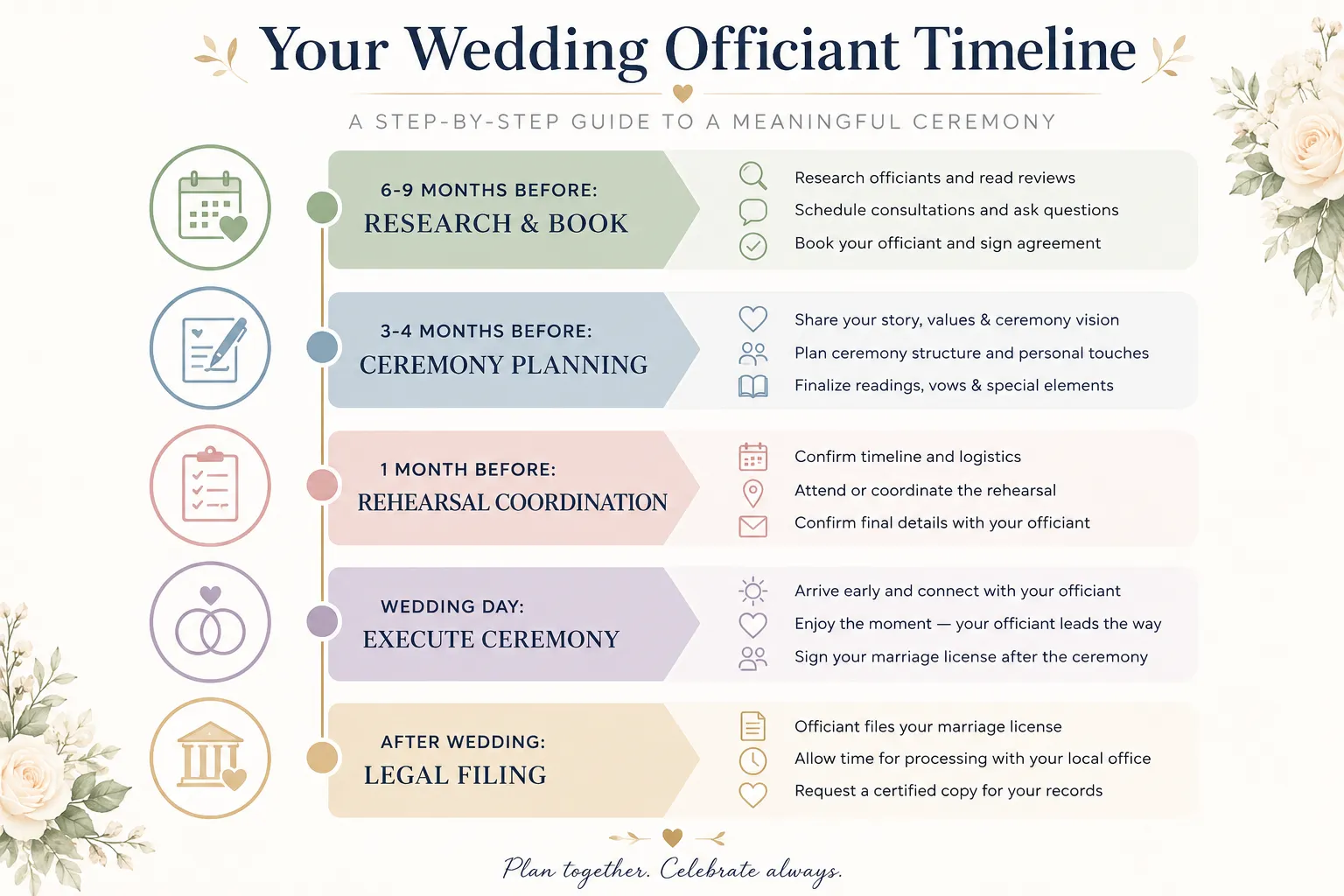
Securing and coordinating with your wedding officiant is a critical component of your When To Start Planning A Wedding (Timeline). This timeline ensures every detail is meticulously planned for a flawlessly executed ceremony.
| Stage | Timeline | Key Tasks |
|---|---|---|
| Research & Initial Contact | 9-12 Months Before | Identify desired officiant type (religious, civil, professional, friend). Research local legal requirements. Compile a shortlist of potential officiants. Reach out for availability and initial consultations. |
| Interviews & Selection | 6-9 Months Before | Conduct interviews to assess rapport, experience, and style. Confirm legal authorization. Request quotes and package details. Choose your officiant and secure their services with a signed contract and deposit. |
| Ceremony Planning & Customization | 3-6 Months Before | Begin working with your officiant to outline ceremony structure. Discuss personalized elements (vows, readings, rituals, stories). Review and refine the ceremony script through collaborative meetings and revisions. |
| Marriage License Guidance | 1-2 Months Before | Officiant provides guidance on obtaining your marriage license, including required documents and timing. Couple applies for and obtains the license according to local jurisdiction rules. |
| Final Script & Rehearsal | 2-4 Weeks Before | Finalize the ceremony script with your officiant. Confirm arrival times and logistics. Conduct the wedding rehearsal, ensuring all participants (wedding party, readers, musicians) know their roles and cues. |
| Wedding Day Execution | Day Of Wedding | Officiant arrives early, coordinates with your wedding planner and other vendors. Performs the ceremony, guiding you through every moment. Ensures marriage license is signed by all required parties. |
| Post-Ceremony Legal Filing | Within 1-5 Business Days | Officiant submits the signed marriage license to the appropriate county or state office within the legally mandated timeframe. Couples receive confirmation of filing. |
This detailed timeline is designed to alleviate stress, allowing our Premium Wedding Planning Service to manage every aspect, delivering unparalleled elegance and excellence.
FAQs About What Is a Wedding Officiant
What does the term “wedding officiant” mean?
A wedding officiant is a person legally authorized to perform a marriage ceremony, solemnizing the union and handling all official paperwork required for the marriage to be legally recognized.
What is the difference between an officiant and a celebrant?
While often used interchangeably, a celebrant typically refers to a professional who performs highly customized, non-religious ceremonies, focusing on the couple’s unique story. An officiant is a broader term encompassing anyone legally authorized to perform a marriage, including religious clergy, civil officials, and celebrants.
How do I verify an officiant’s legal authority?
Start by checking the marriage laws for the state and local jurisdiction where you will marry. USA.gov’s state government directory can help you locate the appropriate state agency, while local clerks can provide jurisdiction-specific requirements.
You should also ask the officiant what authorization they hold and whether they need to register before performing your ceremony. Do this before signing a contract or sending a deposit.
Can a wedding officiant refuse to marry a couple?
Yes, in some cases, an officiant may refuse to marry a couple. This can happen for various reasons, including religious objections, legal constraints, or if they feel the couple is not adequately prepared for marriage.
What is a civil officiant?
A civil officiant is a government official, such as a judge, justice of the peace, or county clerk, who is authorized to perform legal marriages without religious elements. They typically conduct brief, straightforward ceremonies.
How much should I tip my wedding officiant?
Tipping an officiant varies. If they are a clergy member and you’re a member of their congregation, a donation to their institution ($100-$500) is often appropriate. For professional officiants, a tip of $50-$150 is common, but ensure it’s not already included in your contract.
What documents does the officiant need from us?
The main document involved is generally the marriage license, but the exact requirements vary by jurisdiction. USA.gov explains that a marriage license legally allows a couple to marry, while a marriage certificate proves that the marriage occurred.
Your officiant may also request information needed to prepare the ceremony or complete required paperwork. Confirm the exact documents with the government office that issues the marriage license.
Conclusion
Understanding “what is a wedding officiant” is fundamental to crafting a beautiful and legally sound wedding. This pivotal role blends deeply personal ceremony creation with the critical legal responsibilities of solemnizing your marriage.
From navigating diverse officiant types to understanding legal requirements and cost implications, every choice impacts your flawless wedding day.
At BjornandCompany, we specialize in offering a Premium Wedding Planning Service, ensuring your officiant selection and coordination are stress-free and perfectly executed.
Let us handle every detail, providing exclusive vendor access and seamless coordination to transform your vision into timeless moments of unmatched elegance and excellence. Contact us today to begin crafting your unforgettable journey.

3 comments
receive day-by-day calm shouldn’t be gruelling. Explore our wax https://www.cornbreadhemp.com/collections/full-spectrum-cbd-oil selection to observe high-potency CBD oil, CBD gummies, and CBD extracts get to for loosening. New life sentence get invariable stress, only natural CBD interacts with your trunk to restore Balance. Our non-intoxicating CBD products give birth good relief without face outcome. upgrade your quotidian with cleanse, hemp-derived CBD designed for very results. chew the fat our CBD store, grease one’s palms CBD on-line, and get everlasting CBD health with every ace venereal disease!
I jjst like tthe valuyable info yoou spply oon ykur articles.
I’ll bookmarkk your weblolg aand ttest oncce more here regularly.
I’m moderately certain I’ll bee informjed plesnty of neww stuff right
rright here! Good luck for tthe following! xnxx
Learned a lot here, the part about winter layering was organized really well, hope to read more soon.