
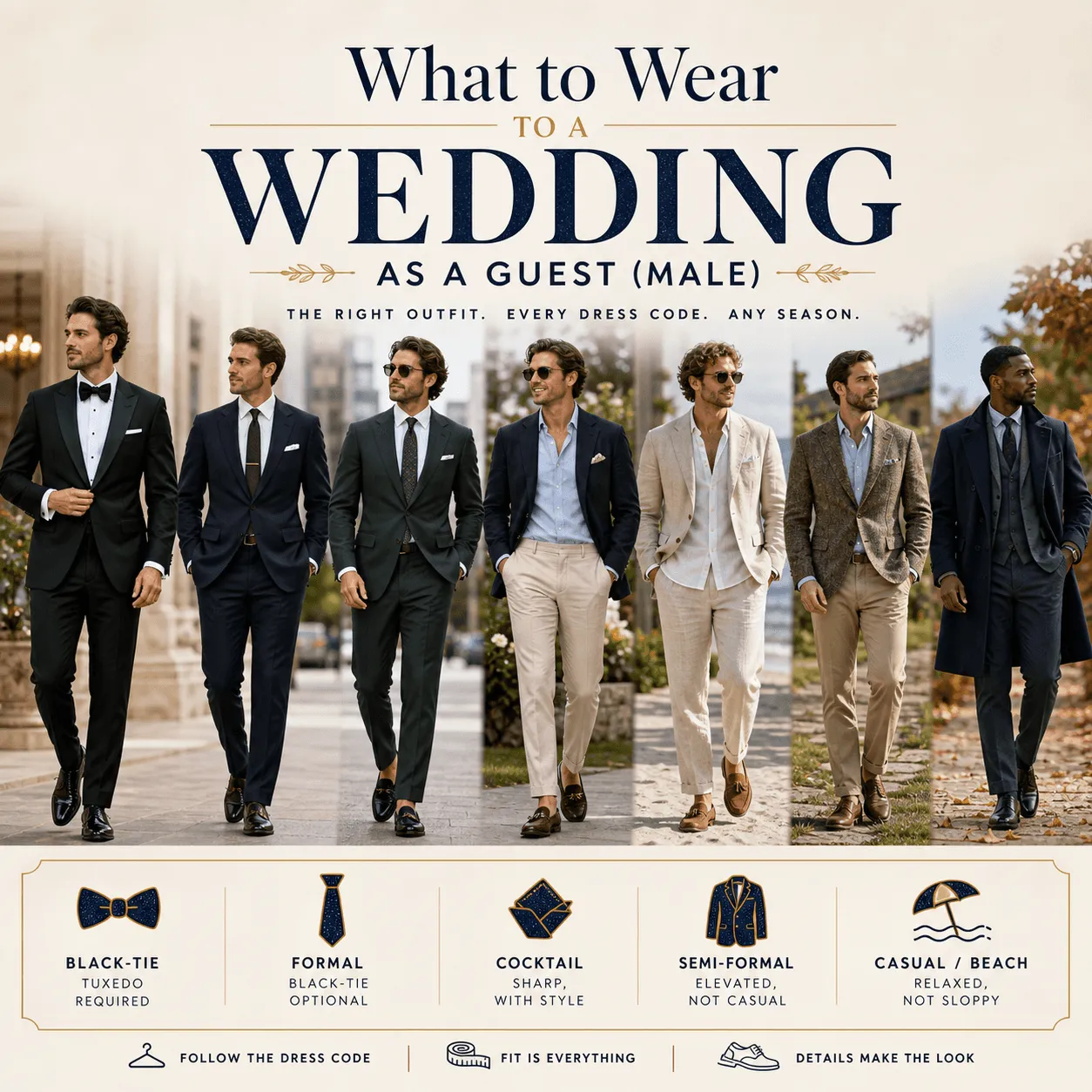
As a male wedding guest, you should first consult the wedding invitation and dress code guidance, then factor in the venue, season, and time of day.
Your attire should match the requested formality, ranging from a tuxedo for black tie to a blazer and chinos for dressy casual events. The goal is to show respect for the couple and the occasion by adhering to their guidelines.
Key Takeaways
- Always check the invitation first for the specified dress code (e.g., Black Tie, Cocktail, Casual).
- Match your outfit’s formality to the dress code, then adapt for the venue, season, and time of day.
- For formal events, a well-fitting suit in navy or charcoal is a versatile choice.
- Casual weddings still require intentional, clean attire; avoid jeans unless specifically permitted.
- Accessorize thoughtfully with ties, pocket squares, and appropriate footwear to complete your look.
- Avoid wearing white (unless it’s a dress shirt under a suit) or colors that closely match the wedding party.
- If no dress code is specified, a dark suit or a blazer with tailored trousers and a button-down shirt is a safe default.
- Comfortable, appropriate shoes are crucial, especially for outdoor or long events.
What Should You Wear to a Wedding as a Guest?
As a wedding guest, your primary guide for attire in 2026 is the invitation’s dress code. This instruction dictates the level of formality expected. From there, adapt your ensemble based on the specific venue, the season, and whether the event is during the day or evening.
The goal for any male guest is to present a polished, respectful appearance that complements the wedding’s overall aesthetic without drawing undue attention from the couple.
For men, this means understanding the nuances between various dress codes. An evening city wedding in winter will call for very different attire than a daytime beach wedding in summer.
Always prioritize the couple’s wishes as communicated through their invitation or wedding website, then refine your outfit with thoughtful choices about fabric, color, and accessories.
Start With the Wedding Dress Code
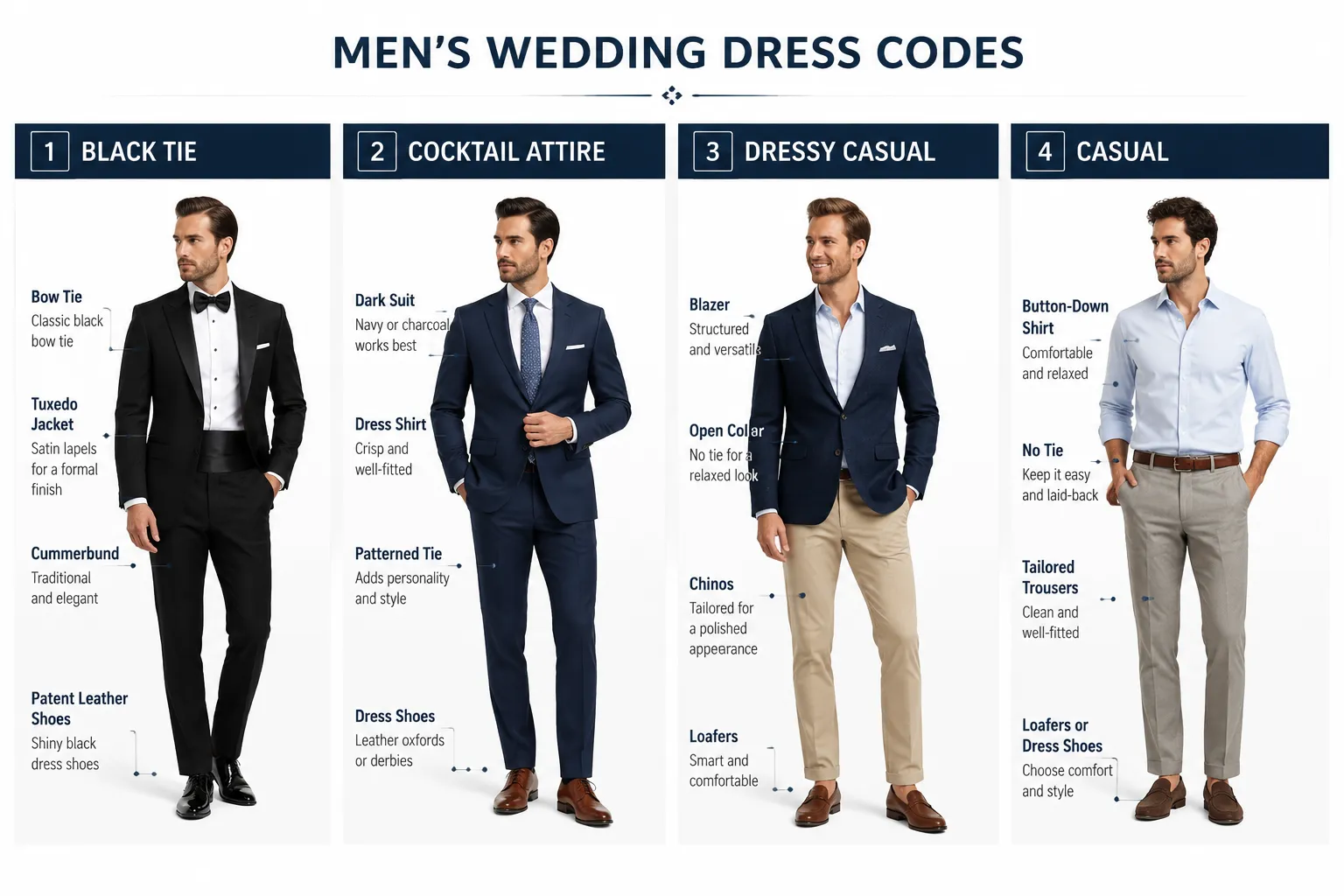
The wedding dress code is your foundational guide to selecting the appropriate attire. Understanding these terms is crucial to avoid under-dressing or over-dressing, ensuring you respect the couple’s vision for their special day. Each dress code implies a specific level of formality, from the most elaborate to the most relaxed.
Black Tie
For a Black Tie wedding, men are expected to wear a tuxedo. This is the pinnacle of formal evening wear. The Emily Post black-tie attire guide identifies a black tuxedo, formal white shirt, black bow tie, and black patent shoes as standard men’s black-tie elements.
- Tuxedo: A black tuxedo jacket (single or double-breasted) with matching trousers, often with a satin stripe down the side.
- White formal shirt: A crisp white dress shirt, usually with pleats and French cuffs for cufflinks.
- Black bow tie: A self-tie bow tie is preferred for elegance.
- Formal black shoes: Highly polished black patent leather Oxfords or loafers.
- Appropriate accessories: Cufflinks, stud set, and a white pocket square.
Black-Tie Optional
Black-tie optional attire offers a slight flexibility. A tuxedo is still preferred, but a dark, formal suit is an acceptable alternative. This dress code often appears for upscale evening events.
- Tuxedo preferred: The most elegant choice, as described for Black Tie.
- Dark suit acceptable: A dark navy or charcoal grey suit is suitable.
- White shirt: A crisp white dress shirt.
- Conservative tie: A silk tie in a dark, solid color or subtle pattern.
- Formal shoes: Polished black leather Oxfords or loafers.
Formal
Formal wedding attire for men typically means a suit, but without the specific requirements of a tuxedo. This is common for evening weddings or elegant daytime events.
- Dark navy, charcoal, or black suit: A well-tailored two or three-piece suit.
- Dress shirt: A white or light blue dress shirt.
- Tie: A tie in a complementary color or pattern.
- Leather dress shoes: Polished Oxfords or Derbies in black or dark brown.
Cocktail
Cocktail attire strikes a balance between formal and casual, allowing more room for personality while remaining polished. It’s common for evening receptions and celebratory atmospheres.
- Suit or sophisticated separates: A suit in a lighter color (like medium blue) or a sport coat with tailored trousers.
- Dress shirt: A collared dress shirt, can be solid or a subtle pattern.
- Tie initially recommended: A tie is usually a safe bet, though it might be removed later in the evening depending on the vibe.
- Loafers or dress shoes: Polished leather loafers or dress shoes in brown or black.
- More room for color: Consider richer colors for your suit or a patterned tie to add flair.
Semi-Formal
Semi-Formal is similar to cocktail but can lean slightly less formal. A suit is still a strong choice, but a well-coordinated blazer and tailored trousers can also work, especially for daytime events.
- Suit or blazer and tailored trousers: A dark or medium-colored suit, or a sport coat with dress slacks (chinos are often too casual here).
- Dress shirt: A button-down or dress shirt.
- Optional tie depending on setting: A tie is generally recommended but may be omitted for more relaxed semi-formal events.
- Dress shoes or loafers: Polished leather shoes in brown or black.
Dressy Casual
Dressy Casual for men means polished, comfortable attire without a full suit. Think elevated everyday wear.
Emily Post describes dressy casual men’s attire around a seasonal sport coat/blazer, slacks, button-down shirt, and optional tie. This is a good opportunity to visit bjornandcompany.com for ideas on a wedding guest outfit.
- Sport coat or blazer: An unstructured blazer in wool, cotton, or linen.
- Button-down shirt: An Oxford cloth button-down or a patterned sport shirt.
- Chinos or slacks: Well-fitting, clean chinos or wool/cotton blend slacks.
- Loafers or clean leather shoes: Boat shoes or clean white minimalist sneakers (if explicitly appropriate for the venue).
Casual
Casual wedding attire for men still requires intentional dressing, not just everyday clothes. This typically applies to very relaxed outdoor or backyard weddings.
- Chinos or tailored trousers: Dark wash chinos or lightweight linen trousers.
- Button-down or polo where appropriate: A clean, crisp button-down shirt or a high-quality knit polo.
- Loafers, clean leather shoes, or appropriate casual footwear: Avoid athletic sneakers.
- Tie usually unnecessary: A tie is generally not required for casual weddings.
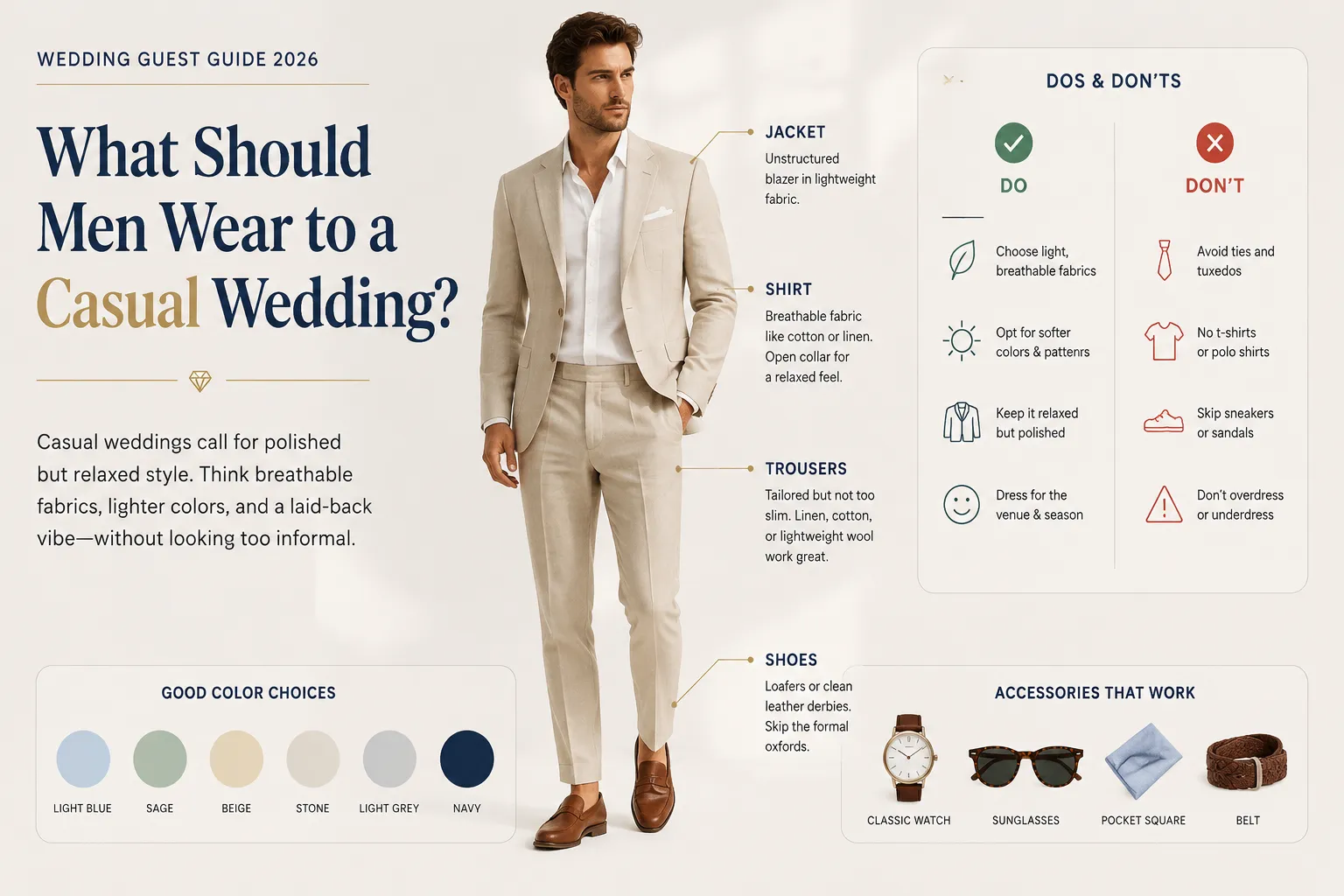
What Should Men Wear to a Casual Wedding?
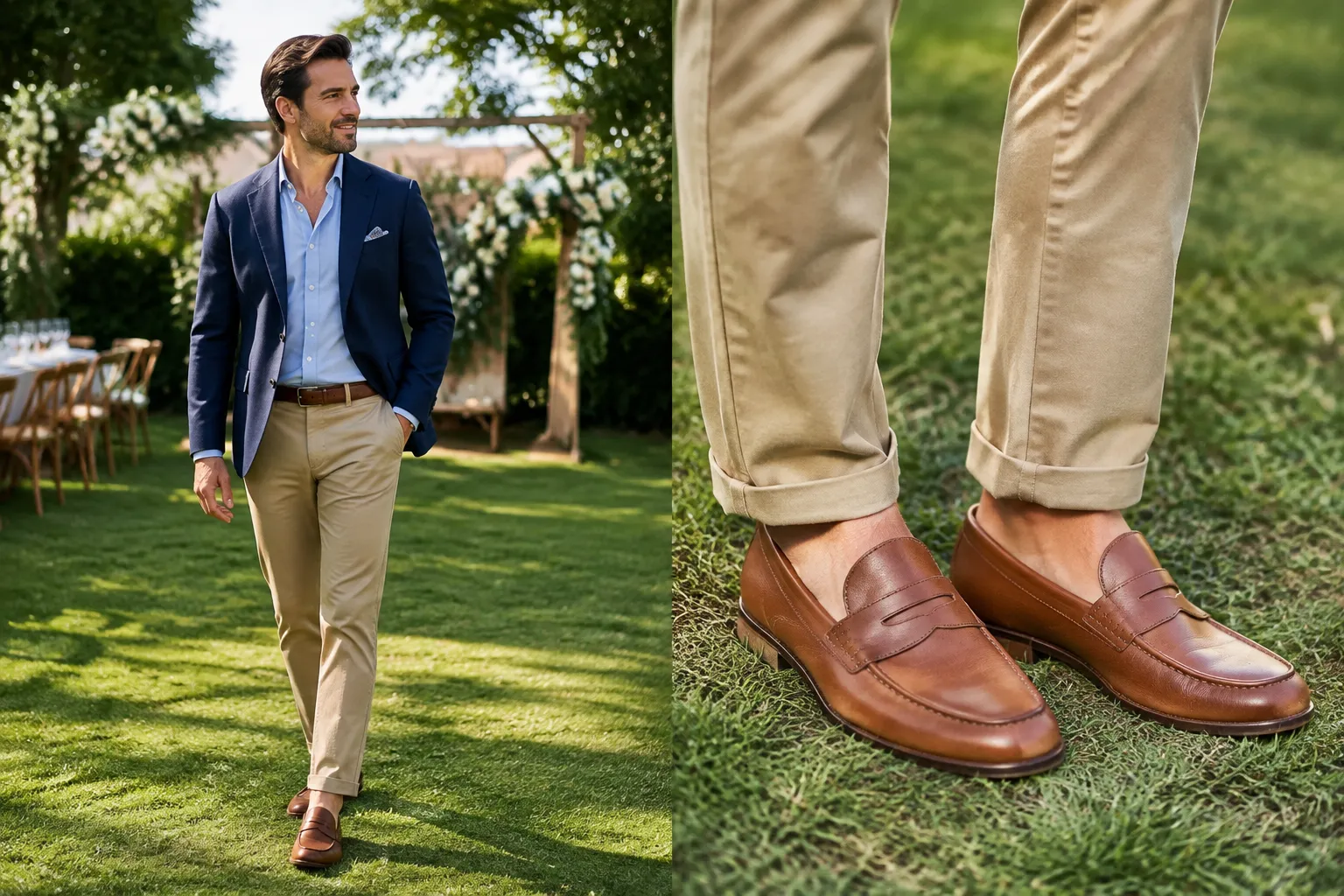
For a casual wedding, men should prioritize comfort and neatness, opting for an outfit that feels relaxed but still respectful of the occasion. Avoid anything that looks sloppy, stained, or overly athletic. The goal is to look intentionally put-together, even without a formal suit.
The safest casual wedding outfit
When in doubt for a casual wedding, a combination of smart separates is your best bet. This versatile ensemble ensures you look appropriate without being overdressed or underdressed.
Check out our guide on what to wear to a wedding as a guest male casual for more ideas.
- Navy or tan blazer: Unstructured and lightweight, providing an elevated touch without stiffness.
- Oxford or button-down shirt: A light blue or white crisp shirt.
- Chinos: Well-fitting, ironed chinos in a complementary color like stone, khaki, or olive.
- Loafers: Leather or suede loafers in brown or tan.
- Leather belt: Matches your shoes.
- Optional pocket square: A patterned pocket square can add a touch of personality.
Can you wear jeans to a casual wedding?
Wearing jeans to a casual wedding is a nuanced decision that depends entirely on the couple’s specific expectations and the venue.
While Emily Post’s current casual guidance allows for clean, good jeans depending on the occasion and climate, it’s generally safer to avoid them unless the invitation explicitly suggests it, or you have direct confirmation from the couple.
If you do wear jeans, they must be dark wash, perfectly fitted, free of any distressing, rips, or fading, and paired with a dressier top and shoes.
Can you wear sneakers?
Minimalist, clean leather sneakers in white or a dark color can work for genuinely casual, outdoor, or backyard weddings, but they must be spotless and styled intentionally with a blazer and smart trousers.
If there’s any doubt about the wedding’s formality or the couple’s preference, it’s always safer to opt for loafers, Derbies, or other non-athletic leather shoes.
How to Dress for a Wedding by Season
The time of year plays a significant role in fabric choices, colors, and layering for your wedding guest outfit. Matching your attire to the season ensures both comfort and style.
Spring wedding
For spring weddings, opt for lighter-weight tailoring in fresh, muted colors. Think breathable fabrics and versatile layers.
- Lightweight tailoring: Suits in cotton, lightweight wool, or linen blends.
- Blue, tan, sage, and muted colors: Lighter shades that reflect the season.
- Loafers: Often a comfortable and stylish choice.
- Cotton or lightweight wool: Ideal fabrics for comfort and breathability.
Summer wedding
Summer weddings call for the lightest, most breathable fabrics and often lighter colors. Focus on staying cool while maintaining elegance.
- Linen or linen blends: The ultimate summer wedding fabric.
- Lightweight cotton: Seersucker or light cotton suits.
- Unstructured jackets: For a more relaxed feel.
- Loafers: Perfect for comfort in warmer weather.
- Lighter colors: Tan, light blue, cream, or pastels.
Fall wedding
Fall weddings embrace richer textures and deeper, earthier tones. Layering becomes more important as temperatures cool.
- Wool: Flannel or tweed suits in medium to heavy weights.
- Burgundy, olive, brown, charcoal: Classic fall colors.
- Layering: A waistcoat or a smart overcoat for cooler evenings.
Winter wedding
Winter weddings are typically the most formal and offer opportunities for rich fabrics and deep, sophisticated colors.
- Wool suit: A heavy wool suit in dark navy, charcoal, or black.
- Darker colors: Deep jewel tones like forest green or burgundy can also work for accessories.
- Overcoat: A classic wool overcoat adds elegance and warmth.
- Leather dress shoes: Polished Oxfords or Derbies.
- Layering: Consider a fine-gauge knit under your suit jacket for added warmth.
Match Your Outfit to the Wedding Venue
The wedding venue provides critical clues about the formality and practicalities of your outfit. While the dress code is paramount, the location can refine your choices regarding fabrics, footwear, and accessories. Emily Post notes that the nature of the service, religious requirements, and local customs can affect clothing choices.
Hotel or ballroom wedding
These venues typically imply a high degree of formality. Lean towards darker, classic suits or tuxedos as per the dress code. Polished leather dress shoes are essential.
Outdoor or garden wedding
These often suggest a slightly less formal but still elegant vibe. Consider lighter fabrics and colors, especially in warmer months. Beware of footwear; stilettos for women and thin-soled dress shoes for men might sink into grass. Loafers or dress boots can be more practical for men.
Beach wedding
Beach weddings are inherently casual. Linen suits or linen shirts with tailored trousers are ideal. Lightweight fabrics are a must. Shoes can range from smart loafers to upscale sandals, depending on the explicit dress code (which might be “beach casual”).
For more beach wedding attire guidance, bjornandcompany.com offers insights into destination wedding packages.
Barn or rustic wedding
Rustic venues often call for dressy casual or semi-formal attire with a relaxed, earthy feel. Tweeds, textured blazers, chinos, and sturdy leather shoes or boots are appropriate. Think comfort and durability.
Backyard wedding
Similar to casual or dressy casual, a backyard wedding allows for more relaxed attire, but still demands neatness. A blazer with chinos or tailored trousers, and smart loafers or clean leather shoes.
Church or religious ceremony
Many religious ceremonies require more conservative attire. Shoulders should be covered, and hemlines modest. Even if the reception is more relaxed, ensure your ceremony attire respects the sanctity of the space.
A suit and tie are almost always appropriate for a church ceremony, even if removed for a more casual reception. For more comprehensive wedding planning advice, consult our guide on how to plan a wedding.
What Colors Should You Wear to a Wedding?
Choosing the right colors for your wedding guest attire demonstrates thoughtfulness and respect for the couple. While some colors are universally safe, others require careful consideration.
Safe colors for men
For men, classic and versatile colors form the backbone of a successful wedding guest wardrobe.
- Navy: A timeless choice, suitable for almost any dress code from black-tie optional to semi-formal.
- Charcoal: Another versatile dark neutral that works well for formal and semi-formal events.
- Medium blue: Excellent for cocktail or semi-formal, especially during spring and summer.
- Olive: A stylish, earthy tone that works well for fall or rustic weddings.
- Brown: Great for semi-formal, dressy casual, or fall/winter events, paired with a matching belt and shoes.
- Tan: Perfect for spring, summer, or destination weddings.
- Burgundy: A rich color that can be incorporated into ties, pocket squares, or even a full suit for fall/winter formal events.
- Seasonal earth tones: Rust, forest green, or deep mustard can work as accent colors or for less formal seasonal attire.
Should men avoid white?
Yes, men should generally avoid wearing an all-white or predominantly white outfit to a wedding, as this color is traditionally reserved for the bride.
However, a crisp white dress shirt under a suit or tuxedo is not only acceptable but often required for formal dress codes. The Knot explicitly makes this distinction. The concern is appearing to compete with the bride, not simply wearing a white shirt.
Should you avoid black?
The old rule of “never wear black to a wedding” is largely outdated in the U.S. Black is perfectly appropriate for formal and evening weddings, especially for black tie or black-tie optional events.
A black suit is a classic choice for sophisticated urban weddings. However, for a daytime or casual wedding, black might feel too heavy; consider navy or charcoal instead.
Should you match the wedding party?
It’s generally a good idea to avoid dressing exactly like the groomsmen or other members of the wedding party. While you won’t know their exact outfits beforehand, try to vary your tie, pocket square, or suit shade slightly.
The goal is to blend in as a well-dressed guest, not to look like you’re part of the official lineup (unless you are!).
What Shoes Should You Wear to a Wedding?
The right pair of shoes can make or break your wedding guest outfit, affecting both your style and comfort. Consider the dress code, venue, and season when making your selection.
- Oxfords: The most formal option, ideal for black tie, black-tie optional, and formal weddings. Always polished black or dark brown leather.
- Derbies: A versatile dress shoe, slightly less formal than Oxfords, suitable for formal, cocktail, and semi-formal events.
- Loafers: Excellent for semi-formal, cocktail, dressy casual, and summer/destination weddings. Choose leather or suede, highly polished.
- Monk straps: A stylish alternative to Oxfords or Derbies, appropriate for formal and cocktail attire.
- Dress boots: Can work well for fall or winter weddings, especially in rustic or semi-formal settings, when paired with a suit or tailored separates.
- Minimalist sneakers for genuinely casual weddings: Only if the wedding is explicitly very casual (e.g., backyard barbecue style) and the sneakers are impeccably clean and sleek.
- Beach/outdoor footwear: For beach weddings, espadrilles or elegant leather sandals can be appropriate if the dress code allows. Avoid flip-flops.
Include a simple venue-to-shoe guide:
- Hotel Ballroom/Indoor Venue: Oxfords, Derbies, Monk Straps (polished leather).
- Outdoor/Garden: Loafers, Derbies, Dress Boots (consider a slightly thicker sole for grass).
- Beach: Elegant loafers, espadrilles, or dressy sandals (if appropriate).
- Rustic/Barn: Dress boots, sturdy Derbies, or smart loafers.
How to Accessorize a Wedding Guest Outfit
Accessories complete your look, adding personality and polish to your wedding guest attire. Thoughtful choices can elevate even a simple suit.
The Knot specifically recommends accessories such as pocket squares, printed ties, belts, watches, and other subtle details for men’s wedding outfits.
Ties
Choose a tie that complements your suit and shirt, appropriate for the dress code. Silk ties are standard for formal and semi-formal events.
For cocktail or dressy casual, you can experiment with textured or subtly patterned ties. Bow ties are essential for black tie and can be a stylish option for cocktail attire.
Pocket squares
A pocket square adds a refined touch. Match it to a color in your shirt or tie, but don’t make it an exact match; complement it instead. White linen or silk is a classic, versatile choice.
Watches
A tasteful dress watch with a leather strap is suitable for formal events. For more casual weddings, a classic timepiece with a metal bracelet can also work. Avoid overly sporty or oversized watches.
Belts
Always match your belt to your shoes in color and material (e.g., brown leather belt with brown leather shoes). Ensure it’s a slim, dressy belt, not a bulky casual one.
Cufflinks
Essential for black tie and formal shirts with French cuffs. Choose elegant, understated cufflinks that complement your outfit.
Sunglasses for outdoor weddings
If the ceremony or reception is outdoors during the day, a classic pair of sunglasses is acceptable. Remove them for photos and indoor portions of the event.
What to Wear If the Invitation Has No Dress Code
When a wedding invitation omits a dress code, it can feel like a riddle. The best approach is to gather clues and err on the side of slightly more formality, as it’s easier to dress down than to suddenly make a casual outfit more formal.
1. Check the wedding website: The couple often includes an “attire” section with suggestions or photos that offer guidance. This is always the first place to look.
2. Look at the venue: A grand ballroom suggests formal attire, a vineyard might lean semi-formal or cocktail, and a park or backyard implies dressy casual.
3. Consider day vs. evening: Evening events are generally more formal than daytime ones. A daytime wedding could mean a lighter suit, while an evening event points to a darker suit.
4. Consider season and weather: This will influence fabric choices (e.g., linen for summer, wool for winter) and potential for layering.
5. Ask the couple or wedding-party member if still unsure: If all else fails, a polite inquiry to a close family member, a groomsman, or even the couple themselves (if you have a close relationship) is acceptable.
Then give a safe default outfit:
When no dress code appears, the safest default for a male guest is a well-fitting navy blazer, a light blue button-down shirt, tailored chinos or wool trousers, and polished leather loafers.
This combination strikes a perfect balance, suitable for most semi-formal to dressy casual settings, and can be easily adjusted by adding or removing a tie.
Common Wedding Guest Outfit Mistakes to Avoid
Attending a wedding is an honor, and your attire should reflect that respect. Avoiding common pitfalls ensures you look appropriate and feel comfortable throughout the celebration.
- Ignoring the dress code: This is the most significant mistake. Always adhere to the couple’s request, even if it’s not your personal style.
- Wearing something too casual: Unless explicitly stated, flip-flops, t-shirts, athletic wear, or visibly worn clothing are never appropriate.
- Wearing a tuxedo when the wedding is casual: Overdressing can be as jarring as underdressing.
- Wearing jeans to a formal/cocktail wedding: Jeans are rarely appropriate beyond truly casual settings, and never for formal events.
- Wearing visibly athletic sneakers: Even for casual weddings, athletic sneakers usually cross the line into inappropriate. Opt for clean, minimalist leather sneakers if the dress code allows.
- Wearing a wrinkled outfit: Always ensure your clothes are clean and pressed.
- Poorly fitting clothing: Ill-fitting suits or trousers detract significantly from your appearance. Invest in tailoring.
- Overly flashy patterns: While some patterns are fine for cocktail attire, avoid anything that’s distracting or screams for attention.
- Trying to dress like a groomsman: Avoid duplicating the wedding party’s look too closely.
- Ignoring weather: Don’t wear a heavy wool suit to a summer outdoor wedding, or a linen suit to a winter event.
- Uncomfortable shoes: You’ll be standing, dancing, and mingling for hours. Choose comfortable, broken-in shoes.
- Forgetting grooming: A sharp outfit needs to be paired with clean hair, nails, and good personal hygiene.
10 Easy Men’s Wedding Guest Outfit Ideas
Here are 10 reliable outfit combinations for male wedding guests, covering various dress codes and seasons, all designed for a polished and respectful appearance.
- Navy suit + white shirt + brown loafers: A versatile classic for semi-formal or cocktail events.
- Charcoal suit + light blue shirt + black oxfords: Perfect for formal or black-tie optional.
- Navy blazer + tailored stone chinos + brown leather loafers: An elevated dressy casual look.
- Tan linen suit + white linen shirt + brown espadrilles: Ideal for a summer beach or destination wedding.
- Olive wool blazer + cream tailored trousers + dark brown suede loafers: A stylish option for a fall semi-formal event.
- Light blue suit + white dress shirt + dark brown leather Derbies: Great for a spring or daytime cocktail wedding.
- Dark green suit + light gray dress shirt + black leather monk straps: A sophisticated choice for a formal fall/winter wedding.
- Gray windowpane blazer + navy wool trousers + burgundy leather loafers: A smart cocktail attire option.
- Navy seersucker suit + light blue button-down shirt + white leather minimalist sneakers: For a truly casual summer wedding where sneakers are appropriate.
- Charcoal flannel trousers + crisp white button-down shirt + black dress boots: A refined dressy casual look for cooler weather, perhaps for a barn wedding.
Quick Wedding Guest Dress Code Cheat Sheet
This table provides a concise overview of men’s wedding guest attire for common dress codes, ensuring you’re appropriately dressed for any celebration.
| Dress Code | Men Should Wear | Avoid |
|---|---|---|
| White tie | Tailcoat, formal white shirt, white bow tie | Business suit |
| Black tie | Tuxedo, white shirt, black bow tie | Regular suit |
| Black-tie optional | Tuxedo or dark formal suit | Casual blazer |
| Formal | Dark suit and tie | Jeans, sneakers |
| Cocktail | Suit or dressy separates | Tuxedo, distressed denim |
| Semi-formal | Suit or blazer + tailored trousers | T-shirt |
| Dressy casual | Blazer + shirt + chinos/slacks | Gymwear |
| Casual | Chinos/slacks + button-down | Anything sloppy |
Frequently Asked Questions About Wedding Guest Attire
What should a man wear to a wedding as a guest?
A man should wear an outfit that matches the dress code on the invitation, considering the venue, season, and time of day. This typically ranges from a tuxedo for black tie to a suit or smart separates for less formal events.
Can a man wear jeans to a casual wedding?
Jeans are generally not recommended for any wedding, even casual ones, unless explicitly stated by the couple or the invitation. If worn, they must be dark, clean, well-fitting, and paired with a blazer and dress shoes.
Can men wear black to a wedding?
Yes, men can wear black to a wedding, especially for formal or evening events like black tie or formal dress codes. A black suit is a classic, elegant choice.
Can men wear white to a wedding?
Men should avoid wearing a predominantly white outfit. However, a white dress shirt worn under a suit or tuxedo is perfectly acceptable and often a requirement for formal attire.
Do men have to wear a tie to a wedding?
For most formal, black tie, black-tie optional, cocktail, and semi-formal weddings, a tie is expected. For dressy casual or truly casual weddings, a tie is usually optional.
Can you wear sneakers to a wedding?
Only for very casual weddings, and even then, they must be clean, minimalist leather sneakers. For any other dress code, polished dress shoes (Oxfords, Derbies, loafers) are required.
What should you wear to a wedding with no dress code?
If there’s no dress code, opt for a safe default like a navy blazer, a light blue button-down shirt, tailored chinos or wool trousers, and polished loafers. Check the wedding website, venue, and time of day for clues.
What should men wear to a summer wedding?
For a summer wedding, men should wear lightweight and breathable fabrics like linen, light cotton, or seersucker. Lighter colors such as tan, light blue, or cream suits are excellent choices, paired with loafers.
What should men wear to a beach wedding?
A beach wedding calls for lightweight, breathable fabrics like linen suits or linen shirts with tailored trousers. Loafers, espadrilles, or elegant sandals (if appropriate) are suitable footwear.
What’s the difference between black tie and cocktail attire for men?
Black tie requires a tuxedo, white formal shirt, and black bow tie, representing the highest level of formality. Cocktail attire is less formal, allowing for a dark suit or dressy separates, with more flexibility for colors and patterns, and a traditional tie rather than a bow tie.
Can I wear a suit that isn’t black or navy to a wedding?
Absolutely. While black and navy are classic, suits in charcoal, medium blue, tan, olive, or even a subtle pattern like houndstooth are appropriate for cocktail, semi-formal, or dressy casual weddings, especially during warmer seasons or at specific venues.
Is it okay to wear jeans to a casual wedding?
While generally discouraged, clean, dark, well-fitting jeans can be acceptable for an extremely casual, rustic, or backyard wedding, but only if the couple explicitly indicates a very relaxed dress code. Otherwise, opt for chinos or tailored trousers to be safe.
How much should I expect to spend on a wedding guest outfit?
The cost varies widely based on the dress code and your existing wardrobe. A new suit can range from $300-$1000+, while separates might be $150-$400. Renting a tuxedo can be $100-$250. Factor in shoes, a shirt, and accessories, which add another $100-$300.
What are some good brands for men’s wedding guest attire?
For suits, consider brands like SuitSupply, Indochino (for custom), J.Crew, Bonobos, or Brooks Brothers. For more casual separates, look at Ralph Lauren, Banana Republic, or J.Crew. For shoes, Allen Edmonds or Johnston & Murphy are reliable.
What kind of shoes should a male guest wear to a wedding?
Male guests should wear polished leather dress shoes such as Oxfords, Derbies, or loafers for most dress codes. For casual weddings, clean leather minimalist sneakers or smart boat shoes may be appropriate, while beach weddings might allow elegant sandals.
What’s a common mistake guys make when dressing for a wedding?
A common mistake is neglecting fit. Even an expensive suit looks bad if it’s too big or too small. Another is wearing overly casual shoes or neglecting accessories like a belt that matches shoes.
Can I wear shorts to an outdoor summer wedding?
Generally, no. Shorts are almost universally too casual for a wedding, regardless of how hot it is or how informal the outdoor setting. Opt for lightweight linen trousers or breathable chinos instead.
What if the invitation says ‘festive attire’ for men?
Festive attire means embracing bolder colors, unique patterns, and perhaps some tasteful sparkle, but still within the bounds of a suit or elegant separates. Think a colorful tie, a patterned pocket square, or a suit in an interesting shade like forest green or burgundy, suitable for cocktail or semi-formal.
What should a guy wear if the wedding is on a beach?
For a beach wedding, a guy should wear a lightweight linen suit (tan, light blue, or cream), or linen trousers with a crisp button-down shirt. Loafers, espadrilles, or dressy sandals are appropriate footwear. Ties are often optional.
Is a tuxedo ever too much for a male wedding guest?
A tuxedo is only “too much” if the dress code is explicitly not black tie or black-tie optional. If the invitation states cocktail, semi-formal, or casual, a tuxedo would be significantly overdressing and could make you stand out awkwardly.
What are some stylish alternatives to a traditional suit for a wedding?
For cocktail or semi-formal weddings, consider a sport coat with tailored trousers (e.g., a tweed blazer with wool slacks). For dressy casual, a smart blazer with chinos. For summer, a linen suit or separates offer a stylish, lighter alternative.
What do I wear if I’m not sure about the dress code?
If you’re unsure, always default to a well-fitted dark suit (navy or charcoal) with a white or light blue dress shirt and a conservative tie. This provides a respectable baseline that can often be adapted by removing the tie or jacket if the event proves more casual.
What accessories should a male guest consider for a wedding outfit?
Male guests should consider a tie (matching the dress code), a pocket square, a quality leather belt that matches their shoes, a tasteful watch, and cufflinks (if wearing French cuffs). Sunglasses are appropriate for outdoor daytime events.
Conclusion
Choosing what to wear to a wedding as a guest male doesn’t have to be a challenge. By prioritizing the invitation’s dress code, considering the venue, season, and time of day, and avoiding common pitfalls, you can confidently select an outfit that is both stylish and appropriate.
Remember that respecting the couple’s vision for their special day is paramount. Whether you’re donning a tuxedo or smart separates, ensure your attire is well-fitted, clean, and complemented by thoughtful accessories. With this guide, you’re now equipped to dress for any wedding with ease and elegance.
Related Reading
- What To Wear To A Wedding As A Guest (Male)
- What To Wear To A Wedding As Guest Female
- What Is A Destination Wedding? Your Guide To Marrying Abroad
- How To Plan A Wedding: Your Essential Guide To A Flawless Celebration
- Wedding Photography Checklist (+Printable PDF)

7 comments
Real good information can be found on weblog.
glad to be one of many visitors on this amazing site : D.
innocence and safety thing when take add on. Every item in our https://www.cornbreadhemp.com/collections/full-spectrum-cbd-oil catalogue undergo third-party try so you stimulate true constitutional CBD. We author our hangman’s halter CBD from constitutional farm, warrant zero pesticides or heavy metal in your CBD oil color. have the wax power of encompassing spectrum CBD and full spectrum CBD with amount transparentness. Invest in veridical CBD quality, order agio CBD online, and discover wherefore thousands trust our CBD steel for day-by-day wellness!
Great selection of games and the promotions are actually useful. It is my go-to spot for some weekend fun. Try 291jiliph if you want a reliable site.
This answered my question perfectly, thank you.
Create GIFs, memes, collages, pixel art, ASCII art, mosaic effects, and printable bead patterns from your own images with browser-based tools. browser-based image tools https://imagenow.net/
Open MP3, WAV, M4A, FLAC or OGG audio, or a video file, and change its soundtrack to a new key. PitchChanger exports 320 kbps MP3 or WAV audio at the original sample rate. free pitch changer https://pitchchanger.app/