
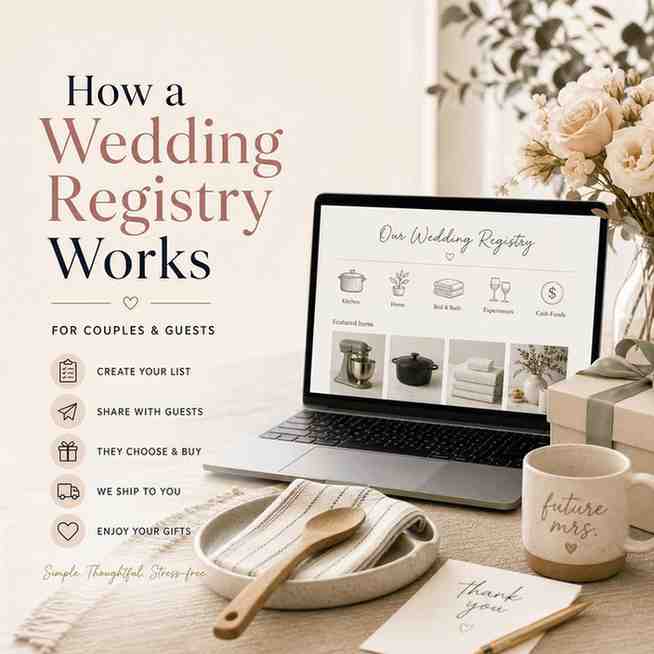
A wedding registry works like a shared shopping list for your guests. You pick what you actually want, guests buy from the list, and the registry tracks purchases and shipping so you do not end up with duplicates.
In this guide, we cover the full flow: how to set up your registry, how guests use it, how gifts get shipped, and how to update your list as you get closer to the wedding.
What is the point of a wedding registry
A wedding registry is the simplest way to tell guests what you want without making things awkward. In plain English, it is a curated wish list created by engaged couples so guests can pick gifts you will truly use.
Here is the core point: it makes gifting easier for guests, and it helps you avoid random gifts and duplicate items. That is still valuable, even if you already live together, even if you do not “need” much, and even if your style is not traditional.
A good registry also sets expectations. Guests can see your taste, your real needs, and your price range. That means fewer last-minute texts like, “What do you want?” and fewer returns you never get around to doing.
This article covers the full flow: guests, gift purchases, shipping and delivery, plus how to keep the registry updated.
Traditional store registries still exist, and they can be great for in-person shoppers. However, for most couples today, a digital registry or universal registry is the default because it is faster, easier to share, and easier to manage.
How does a wedding registry work?
Most registries follow the same simple loop. We like this process because it reduces guest confusion and keeps your gift list clean.
Step 1: Create and customize
You choose a registry platform (like Zola, Amazon, or a specific retailer) and start adding items to your list.
This is where you set the tone. You can add a mix of “everyday useful” and “nice upgrades,” plus cash funds or experiences if you want.
Step 2: Share the list
Most couples share the registry link on a wedding website. It is clear, polite, and easy to find.
You can also share it through word of mouth, family, and wedding shower invites. Many couples avoid printing registry details on the formal wedding invitation, unless that is common in their culture or community.
Step 3: Guest purchases
Guests click the link, browse your list, and choose something at a price point that works for them.
Depending on the registry, guests may buy directly on the platform or get sent to a linked store to check out.
Step 4: Fulfillment and tracking
After someone buys a gift, the registry updates in real time to mark it as purchased or reserved. This helps prevent duplicates.
Then the gift ships to your home, to an alternate address, or gets scheduled for later delivery, depending on your settings.
Behind the scenes, the best registries rely on a few key features:
- Real-time updates so purchased items get marked quickly
- Reserved items so two people do not buy the same thing at once
- Address privacy so guests can ship gifts without seeing your full address
- Clear returns and exchanges so you are not stuck with the wrong size or color
What does a wedding registry consist of?
Modern registries are not just fancy dishes. They are usually a mix of physical gifts, experiences, and money funds across many budgets.
Home goods basics
Most couples start here because it is practical. Useful gifts get used, and guests feel good buying them.
Common home basics include:
- Cookware and bakeware
- Small appliances (toaster oven, blender, coffee maker)
- Knives, cutting boards, and kitchen tools
- Plates, bowls, glassware, and flatware
- Sheets, pillows, comforters, and blankets
- Towels, bath mats, and storage
- Cleaning tools, organizers, laundry items
These are not glamorous, but they make day-to-day life smoother. Still, it is smart to add a few “upgrade” picks too, like a better pan set or a nice vacuum, because weddings are one of the rare times people enjoy giving you a true upgrade.
Experiences and services
Experiences work well when you live in a small space, travel often, or just prefer memories over things.
Examples include:
- Cooking classes
- Date-night gift cards
- Museum passes or local experiences
- Subscriptions (coffee, wine clubs where allowed, meal kits)
- House cleaning service or meal delivery credits
Cash funds
Cash funds are normal now. They are also a relief for guests who do not want to guess your style.
Common fund options:
- Honeymoon fund
- Down payment or first-home fund
- “Newlywed expenses” or general cash fund
Most platforms let guests contribute any amount. Some platforms charge a fee, and some allow fee-free bank transfers. Timing can vary too. In many cases, funds transfer to your bank on a schedule, or after verification steps.
If you add funds, keep the language warm and specific. Guests like knowing what they are supporting, even if it is as simple as “dinners on our honeymoon” or “a couch we will use for movie nights.”
Paper and communication extras
These are not always “registry items,” but they are closely tied to guest gifting and planning:
- Thank you cards
- Engagement announcements
- Address books and guest list tools
If you plan ahead here, your thank-you notes become much easier later.
How do wedding registries work for guests?
From the guest side, a registry should feel simple and low pressure. When it is done well, guests spend less time searching and more time choosing something meaningful.
Finding the registry
Most guests find your registry through your wedding website. They click “Registry,” then see your list and any linked stores.
Browsing and picking a gift
Guests typically browse by category and filter by price. This is why variety matters. A good registry has gifts under $25, mid-range gifts, and a few larger picks.
Clear opinion: guests buy faster when the list is organized. Practical reason: fewer decisions means less stress. Buyer context: most guests shop between tasks, on their phone, and they want it to be quick.
How guests avoid duplicates
Registries prevent duplicates by marking items as purchased (or sometimes “reserved”) once someone checks out.
That said, duplicates can still happen if someone buys off-registry or if two people check out at the exact same time. Still, modern platforms are far better at preventing this than old school paper lists.
Gift messages and gift receipts
Most registries let guests include a short message. Many stores also provide a gift receipt so you can exchange an item without awkward back-and-forth.
We always recommend leaving gift receipts turned on when possible. It makes exchanges feel normal, not personal.
Group gifting
Group gifting lets multiple people contribute to one larger item, like a stand mixer or a luggage set.
From the guest side, it usually looks like this: they choose the big item, pick an amount to contribute, and the registry tracks the rest. It feels good to join in on a “big gift” without paying for the whole thing.
Timing etiquette
Buying earlier helps. It helps you for showers, engagement gifts, and pre-wedding shipping. It also helps guests because popular items are still available.
If most gifts are gone, guests still have options:
- Buy a remaining item and add a personal note
- Contribute to a group gift or cash fund
- Choose a gift card from a store you registered at (if you included one)
Where to register for wedding gifts
Where you register changes the guest experience. It also changes how easy returns and shipping will be for you.
Option 1: Universal registry
A universal registry lets you add items from many sites into one list. Guests still get one link and one place to shop.
Clear opinion: this is the easiest setup for most couples. Practical reason: fewer registries to manage means fewer shipping and tracking headaches. Buyer context: guests want one link, not a scavenger hunt.
Option 2: Single-retailer registry
This can be great if you are loyal to a store or want consistent shipping and returns. It is also simple for guests who already have an account and trust that retailer.
Option 3: Hybrid approach
This works well if you have guests who prefer in-person shopping. You can keep your main list universal, then add one or two familiar stores for local shoppers.
Why couples choose an online universal wedding registry like Zola
Zola comes up often because it keeps things centralized. Couples like having one place for the registry, cash funds, shipping controls, and guest-friendly browsing. It is not the only option, but it fits how people shop now.
Decision factors to consider
- Guest demographics (tech-forward guests vs in-person shoppers)
- Shipping speed and reliability
- Return and exchange policies
- Completion discounts (more on that later)
- Customer support if something goes wrong
When to register for wedding gifts
Most couples do best when they start early. Not because you need gifts early, but because guests shop early.
A common timeline:
- Start your registry soon after you get engaged
- Have a solid “starter registry” ready before shower invites go out
- Keep refining it as your date gets closer
Having a registry early reduces guest stress. People want to celebrate you right away, and they do not want to guess what you need. That said, you do not need a perfect registry on day one. Build the base first, then improve it as you go.
How much to register for wedding gifts
The goal is not to make a massive list. The goal is to give guests enough good choices at different prices.
A practical guideline:
- Include low, mid, and high price points
- Add a few group gifts
- Include more items than your guest count so the registry does not get picked over too early
Clear opinion: variety is more polite than perfection. Practical reason: guests have different budgets and relationships with you. Buyer context: your coworker, your cousin, and your best friend do not shop the same way.
Also, balance “fun” and “useful.” People love buying gifts that feel special. However, you will love gifts that you use weekly.
What’s the best way to do a wedding registry?
A registry works best when it matches your real life, not a fantasy kitchen.
Start with your current setup
Ask:
- What do we already own that we actually like?
- What is worn out, mismatched, or low quality?
- What do we use every week?
If you already have a blender you love, skip it. If your towel set is sad, upgrade it.
Build in layers
We like this order:
- Essentials (kitchen, bedroom, bath)
- Smart upgrades (better versions of what you use)
- Hosting and shared-life items (serveware, bar tools, board games)
- Experiences and cash funds
This keeps the registry useful first, fun second. Still, it leaves room for the big-ticket gifts some guests want to give.
Use universal tools to reduce friction
One link matters. It cuts down on guest questions and makes your registry feel modern.
Plan for shipping realities
Shipping can be the most annoying part if you ignore it.
If you are moving, remodeling, or traveling right after the wedding, consider settings like:
- Hold delivery until after the wedding
- Ship to a trusted alternate address
- Choose items with reliable delivery windows
Use completion discounts on purpose
Some registries and retailers offer a completion discount after the wedding so you can buy leftover items for less.
Smart move: leave a few “nice to have” items for after the wedding, so you can use that discount when the dust settles.
Benefits of a wedding registry
A registry is not just a gift list. It is a planning tool.
Benefits for couples
- Fewer unwanted gifts
- Fewer duplicates
- Easier tracking of who bought what
- Easier returns and exchanges
- Gifts that fit your home and your routine
Benefits for guests
- Confidence they are buying something you want
- Faster shopping
- Easy shipping straight to you
Benefits for everyone
- Less last-minute stress
- Fewer awkward conversations
- Clear thank-you tracking so gratitude does not fall through the cracks
Modern perks that really help:
- Group gifting
- Universal registry shopping
- Address privacy
- Completion discounts
- Centralized purchase tracking
For those expecting a baby, it’s also worth exploring options such as the best baby registry in Canada, which can provide similar benefits tailored specifically for newborn needs.
Shipping, delivery timing, and what happens after someone buys a gift
This is the part most couples worry about, and it is also the part that has improved the most.
Here is the typical flow:
- Guest buys gift
- Item gets marked purchased on the registry
- Order processes through the platform or retailer
- Shipping notifications go out (to the guest, the couple, or both, depending on settings)
- Gift delivers to your chosen address or gets scheduled
Common shipping setups
- Ship immediately: best if you are settled and have space
- Ship later: best if you are moving or leaving for a honeymoon
- Consolidate shipments: some platforms help reduce boxes and delivery chaos
- Alternate address: great for apartment buildings, porch theft concerns, or privacy
Special cases: out of stock, backorders, discontinued items
These happen, especially during busy seasons.
Good registries will show stock status. Still, items can go out of stock after you add them.
If something changes, you usually have options:
- Swap to a similar item
- Let the guest choose a replacement
- Convert to store credit (varies by retailer)
Clear opinion: pick items with steady availability when you can. Practical reason: backorders create guest confusion and delayed gifts. Buyer context: guests want to feel their gift arrived on time.
Returns and exchanges basics
Returns are easier when you choose platforms and stores with clear policies.
Gift receipts help because they let you exchange without asking the guest for details. Some registries also keep a record of purchases to simplify exchanges.
After the wedding: the real-life part
After the wedding, you may need to handle several tasks. This could include storing gifts for a bit, exchanging items that do not fit your space, or buying remaining items with your completion discount. This is all part of the process. To make it easier, consider planning one calm weekend to tackle these tasks, which will help you feel more settled.
For a comprehensive guide on what to do after the wedding, check out this after-the-wedding checklist.
Updating wedding registry
Updating your wedding registry is crucial as guests will continue checking it as the date approaches. Items may sell out, your needs might change, or you might realize you’ve forgotten some essentials.
What to update
To keep your registry relevant and useful, consider the following updates:
- Add more budget-friendly items if the list skews expensive
- Swap out low-quality picks you no longer like
- Add missing basics (extra sheets, serving spoon set, storage bins)
- Refresh experiences or cash funds wording
A simple cadence that works
A quick check weekly or monthly can help maintain the registry. The final refresh should happen 4 to 6 weeks before the wedding.
Common pitfalls to avoid
Be wary of these common pitfalls when updating your registry:
- Too many high-ticket items and not enough everyday picks
- Too few total options, causing the list to get emptied early
- Leaving only random leftovers that do not feel giftable
Tie updates to thank-you notes
Most registry tools track who bought what. This feature can be incredibly helpful when you’re writing thank-you notes. As gifts arrive, add tiny notes about who sent them. When it’s time to write thank-you cards, you’ll appreciate having this information handy. For tips on crafting thoughtful thank-you notes, refer to this guide on how to write a thank-you note.
What a “balanced” registry list can look like
It’s not about having a giant list but rather creating a structure that works effectively for both you and your guests.
Sample balanced mix
Cookware and kitchen basics (5 to 7):
- 12-inch skillet
- Saucepan
- Sheet pan set
- Chef’s knife
- Cutting board
- Mixing bowls
- Food storage set
Linens and bath (3 to 5):
- Sheet set
- Duvet cover
- Towel set
- Bath mat
Hosting (2 to 3):
- Serving platter
- Glassware set
- Salad bowl or pitcher
Group gifts (2):
- Stand mixer or espresso machine
- Luggage set or vacuum upgrade
Experiences (1 to 2):
- Cooking class
- Date-night fund
Cash fund (1):
- Honeymoon fund or home fund
Why this mix works: it hits different budgets, it focuses on daily use, and it leaves room for bigger gifts without making every gift expensive.
It also fits a universal registry well. You can pull these items from different brands and sites, but keep them in one clean list.
The simplest way to make your registry work for everyone
A wedding registry is a curated wish list created by an engaged couple. It guides guests on what to buy, prevents duplicate items, and helps you receive what you need for your new life together.
The flow is simple: create your registry, share one clear link, guests buy gifts, the platform tracks purchases and shipping, and you update the list as life changes.
If you want the easiest next step, pick one platform (many couples like a universal option like Zola), add your essentials first, then expand across price points with a few group gifts and one cash fund. That is the simplest way to make your registry work for everyone.
FAQs (Frequently Asked Questions)
What is a wedding registry and why is it important?
A wedding registry is a curated wish list created by engaged couples to share with their guests, showcasing gifts they truly want and will use. It simplifies gifting, helps avoid duplicates, sets clear expectations on taste and price range, and reduces awkwardness or last-minute gift queries.
How does the typical wedding registry process work?
The wedding registry process involves four simple steps: 1) Create and customize your registry on a platform like Zola or Amazon; 2) Share the registry link via your wedding website or invitations; 3) Guests browse the list and purchase gifts at their preferred price point; 4) The registry updates in real time to track purchases, prevent duplicates, and manage shipping.
What types of items can be included in a modern wedding registry?
Modern registries often include a mix of physical gifts like cookware, small appliances, linens, and cleaning tools; experiences such as cooking classes or museum passes; and cash funds for honeymoons, home down payments, or general expenses. This variety caters to different lifestyles and preferences.
How do cash funds work in a wedding registry?
Cash funds allow guests to contribute money toward specific goals like a honeymoon or home down payment. Most platforms let guests contribute any amount, sometimes charging fees or offering fee-free bank transfers. Funds are usually transferred to the couple’s bank account on a scheduled basis after verification.
Can I update my wedding registry as the wedding date approaches?
Yes, registries can be updated anytime before the wedding. You can add new items, experiences, or funds based on changing needs. Keeping the list current ensures guests have accurate options and helps avoid duplicate gifts.
How do registries handle gift shipping and privacy?
The best registries provide real-time updates marking purchased items to prevent duplicates. They also offer address privacy features so guests can ship gifts without seeing your full address. Gifts can be shipped directly to your home, an alternate address, or scheduled for later delivery depending on your settings.

3 comments
Hello there, You have done an incredible job. I will
definitely digg it and personally recommend to my friends.
I’m confident they’ll be benefited from this site.
The app version is just brilliant. It is way more intuitive than the web version and works like a charm. Definitely download bd7u7app if you want a better experience.
I’ve been trying a few different sites this month and this one really stands out. Great variety of games and the customer support is actually helpful. Check out vnmh66 if you want a stress-free experience.